
SWOT analysis (strengths, weaknesses, opportunities, threats)
Separate what you control from what you do not, back each entry with evidence, and finish with the strategic questions it raises.
- Time
- 45 min
- People
- 4–8
- Kind of work
- Understand · Frame

In short
A SWOT analysis is a four-box review of an organisation, service or plan: internal strengths and weaknesses, and external opportunities and threats. Run well, it separates what you control from outside conditions, asks for evidence behind each entry, and ends with a short list of strategic questions rather than a long list of adjectives.
What it is
SWOT stands for strengths, weaknesses, opportunities and threats. The top two boxes are internal: capabilities, resources and habits the organisation has or lacks. The bottom two are external: changes in the world, such as demand, policy, technology or partners, that could help or harm. It is one of the most widely used strategy tools because it is simple and familiar.
That familiarity is also its weakness. Many SWOTs become long lists of vague words, such as "strong brand" or "changing market", that lead nowhere. This version adds two disciplines. Each entry needs evidence, so claims can be checked. And the session ends by combining boxes into questions, such as how a strength could meet an opportunity, so the analysis feeds real choices.
When to use it
Use it when
- You are starting a strategy or annual planning cycle and need a shared starting picture.
- A team is considering a new service, partnership or investment and wants to test its position.
- New leadership wants a quick, honest view of where an organisation stands.
- You have done an external scan, such as a PESTLE analysis, and need to connect it to your own capabilities.
Skip it when
- The question is narrow and operational, such as why one form is returned; use a fishbone or five whys.
- The group cannot speak openly about weaknesses; the result will be a list of strengths and little else.
- You need to compare specific options; a weighted decision matrix will serve you better.
You need
- Time
- About 45 minutes for one SWOT, plus preparation to gather evidence.
- People
- Four to eight people with different views of the organisation, including at least one close to service users and one with access to data.
- Materials
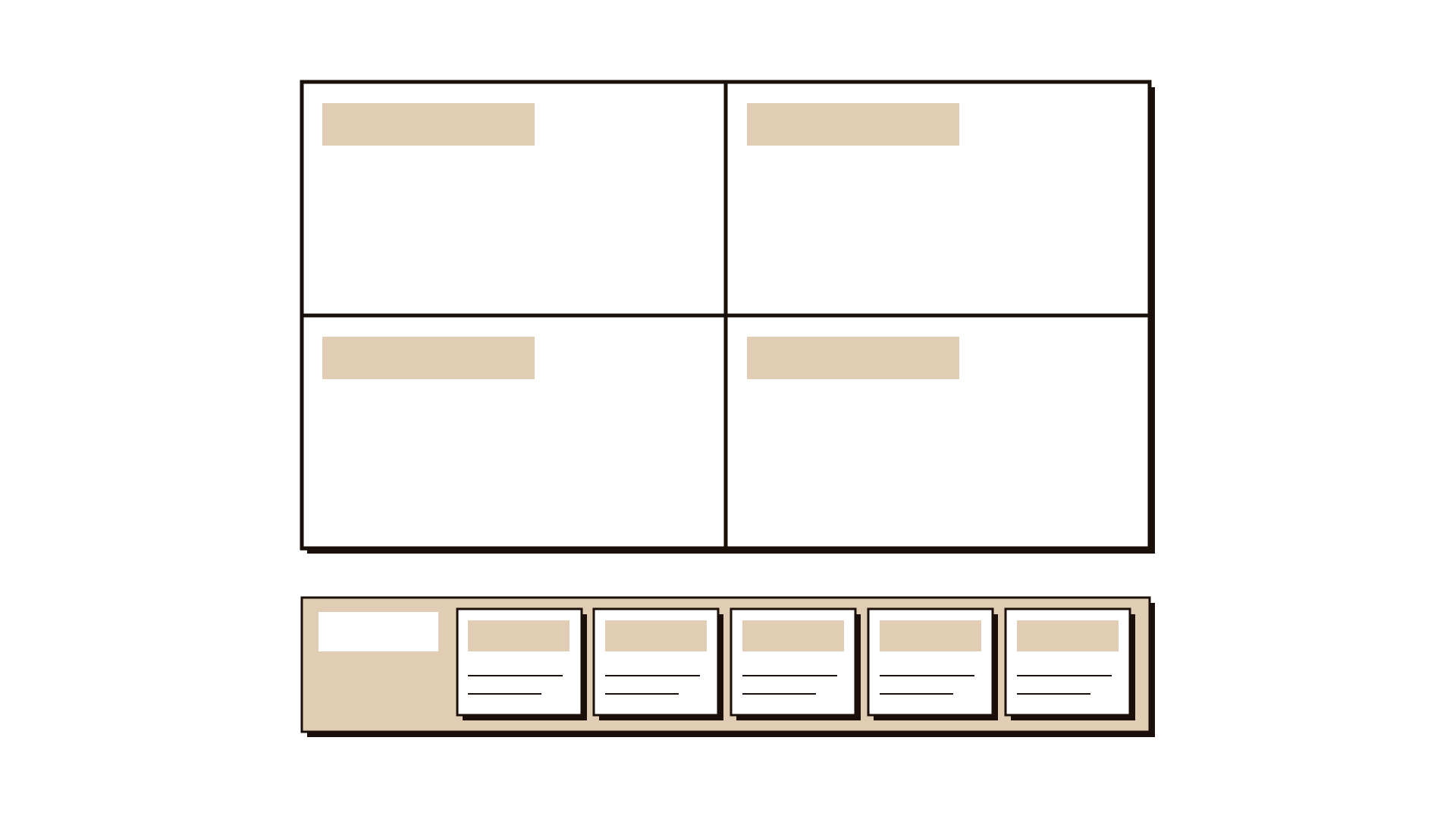
- A board drawn into four boxes with an evidence strip below; sticky notes; any recent data, survey results or external scan; the worksheet with Strength, Weakness, Opportunity, Threat and Evidence.
How to run it
Step 1: Name the subject and the time frame
Write exactly what you are analysing and for which period, such as "the outpatient booking service over the next two years". A SWOT of a whole ministry or company is too broad to be useful. Narrow it to a service, unit or decision.
Step 2: Draw the internal and external line
Explain the line between the top and bottom boxes. Strengths and weaknesses are inside your control: skills, systems, processes, reputation. Opportunities and threats are outside: what users, partners, rules or technology are doing. Many entries end up in the wrong box, so check this as you go.
Step 3: Write entries alone, then share
Give everyone eight minutes to write entries on sticky notes, one per note, for any box. Then each person places their notes. Silent writing first stops the loudest voices from shaping the whole picture.
Step 4: Add evidence to each entry
For each note, ask: how do we know? Add a short reference in the evidence strip: a figure, a survey result, a complaint trend, a policy document. Move unsupported notes to the side as claims to check, rather than deleting them.
Step 5: Sharpen and merge
Rewrite vague entries into specific ones. "Good staff" becomes "Booking staff resolve most queries in one call, according to last quarter's call data." Merge duplicates. Aim for three to six strong entries per box.
Step 6: Combine boxes into questions
Look across the boxes and write questions: how can a strength take up an opportunity? How might a weakness leave us exposed to a threat? Which opportunity needs a weakness fixed first? These questions are the real output of the session.
Step 7: Choose the questions to take forward
Agree the two or three questions that matter most for your next decisions, and who will take each one into strategy work. Photograph the board and share it with the evidence attached.
Worked example
A private university's continuing education unit was deciding whether to expand its short professional courses. Enrolment had been flat for two years, while several employers had asked about tailored programmes.
Strengths included "teaching staff with recent industry roles in four fields", backed by staff records, and "high course satisfaction", backed by end-of-course surveys. Weaknesses included "enrolment handled by paper forms" and "no dedicated contact for employers".
Opportunities included "employers seeking short, tailored upskilling", backed by eleven enquiries in a year, and "a new national funding scheme for workforce training". Threats included "online providers offering similar courses at lower prices", backed by a scan of six competitor offers.
Several notes first placed under strengths, such as "growing demand for data skills", were moved to opportunities because they describe the outside world. Two weaknesses had no evidence and were set aside to check.
The group wrote three questions: how can industry-experienced staff meet employer demand for tailored courses? What must change in enrolment before applying to the funding scheme? Where can the unit avoid competing on price with online providers? Those questions went into the unit's strategy work.
IllustrativeTips and mistakes
Tips
- Keep the subject narrow; a SWOT of one service is more useful than one of a whole organisation.
- Invite people who see weaknesses daily, such as frontline staff, not only senior managers.
- Use a PESTLE analysis or recent scan to make the opportunities and threats specific.
- Write evidence in the same session; claims are hard to challenge once the board is photographed.
- Spend at least a third of the time on the questions, not the lists.
Common mistakes
- Putting outside trends in the strengths box, which blurs what the organisation actually controls.
- Writing single words or slogans that cannot be checked or acted on.
- Stopping at four lists and calling it a strategy, without drawing out any choices.
- Running it only with senior leaders, so weaknesses are understated.
What you walk away with
You leave with an evidence-backed picture of your internal strengths and weaknesses and the external opportunities and threats, plus two or three sharp strategic questions that combine them. That gives your next planning conversation a clear starting point. Take the questions into a strategic choice cascade to decide where to focus, and if the external picture is uncertain, use a scenario matrix to test how your choices hold up in different futures. A PESTLE analysis can deepen the external boxes before you start.
Questions people ask
What is the difference between SWOT and PESTLE?
PESTLE scans only the outside world, across political, economic, social, technological, legal and environmental factors. SWOT combines that outside view with an inside look at your own strengths and weaknesses. Many teams run a PESTLE first and use it to fill the opportunities and threats boxes.
How do you make a SWOT analysis actionable?
Add evidence to each entry, keep the subject narrow, and end by combining boxes into questions, such as how a strength could take up an opportunity. Then take the most important questions into a planning tool. A SWOT that ends with four lists rarely changes anything.
Is a strength the same as an opportunity?
No. A strength is something inside your organisation that you control, such as a skill or system. An opportunity is a change outside that you could take advantage of, such as new demand or a new funding scheme. Keeping them apart is the main discipline of a SWOT.
Tool card
The worksheet your team fills in, one box per field.
- Strength
- Weakness
- Opportunity
- Threat
- Evidence