
Why dot voting lies to you, and how to fix it
Dot voting looks democratic but rewards the familiar, the visible and the senior. Why its results mislead, and how to run a vote you can trust.

Why dot voting lies to you, and how to fix it
Dot voting gives a fast, visible answer to the question "which ideas does this room like?", but it is usually treated as the answer to a different question: "which ideas should we pursue?" Run openly, it rewards ideas that are familiar, easy to understand and already backed by senior people. You can keep its speed and fix most of its flaws by voting silently, voting on one clear criterion at a time, and treating the result as a shortlist rather than a decision.
The belief, stated fairly
The case for dot voting is strong, which is why it appears in nearly every workshop. Everyone gets the same number of dots. Nobody has to argue in public. In ten minutes a wall of sixty notes becomes a visible ranking. It feels fair, it is easy to explain to a group that has never facilitated anything, and it gives the session a clear moment of convergence.
All of that is true. The trouble is what the dots actually measure, and how the act of voting in front of each other changes the result.
Why it fails in practice
It measures popularity, not value. A dot says "I like this" or "I understand this". It does not say "this will work", "this solves the problem we defined" or "we can afford this". Ideas that are easy to grasp in five seconds collect dots. Ideas that need a minute of explanation, often the more original ones, do not.
Votes are visible, so they cascade. When people vote one after another on an open wall, early dots act as a signal. Economists call this an information cascade: people reasonably infer that a crowded note must be good and add to it, even when their own judgement pointed elsewhere. The final ranking says as much about who walked up first as about the ideas.
Hierarchy leaks into the dots. In most organisations people notice where the director put their dots. In cultures where seniority carries real weight, that alone can settle the vote. A process that looks anonymous is not anonymous if everyone watches everyone else.
Wording wins. The note that is written clearly and specifically beats the note scribbled in three words, regardless of the idea underneath. Dot voting quietly rewards good handwriting and confident phrasing.
Splitting hurts good ideas. If three notes describe the same strong idea in different words, the votes divide between them and a weaker idea with one clear note comes out ahead.
Nobody says what the dot means. One person votes for impact, another for ease, a third for what they would enjoy working on. Adding those dots together produces a number with no meaning.
How to fix it
You do not need to abandon dot voting. You need to stop letting it decide on its own.
- Cluster and merge first. Before any vote, group duplicates with affinity grouping and give each cluster one clear title. This stops good ideas from splitting their votes.
- Let authors explain in one sentence. Give each idea thirty seconds so that original ideas are understood before they are judged.
- Name the criterion out loud and write it on the wall. "Put your dots on the ideas most likely to reduce waiting time for first-time customers" is a vote. "Vote for your favourites" is a poll.
- Vote silently and simultaneously. Ask everyone to note their choices privately first, then place them at the same time. Online, hide results until everyone has voted. Senior people vote with everyone else, not first.
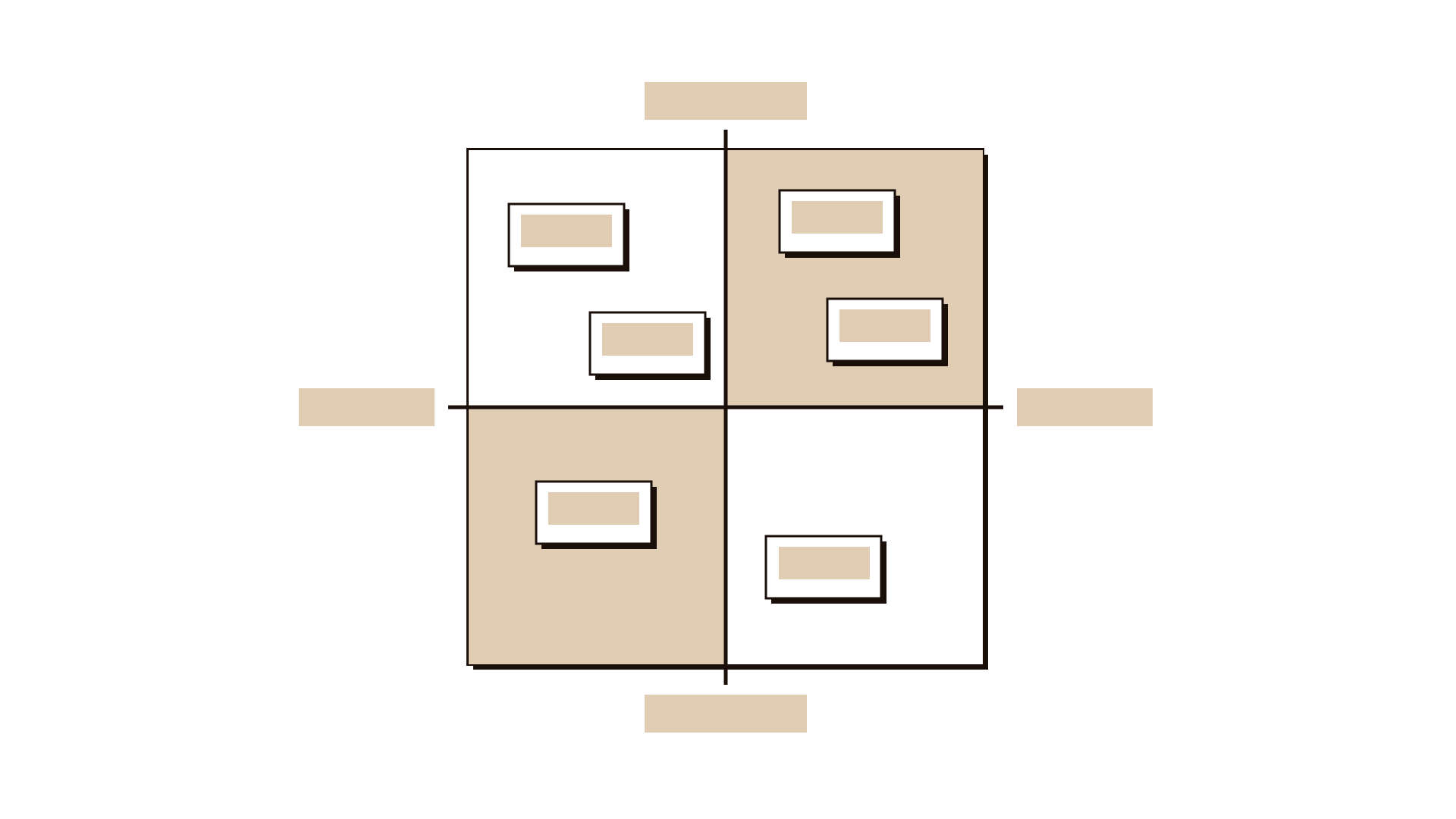
- Use separate colours for separate criteria. For example, green for impact and blue for feasibility. Then plot the results on an impact–effort matrix instead of adding them up.
- Treat the outcome as a shortlist. Take the top five to eight clusters forward to a sharper method: a weighted decision matrix when the stakes are high, Now, How, Wow when you want to separate bold ideas from easy ones, or assumption mapping when you need to know what must be true first.
- Ask about the ideas with no dots. Before closing, ask: "Is there anything here with few dots that someone thinks we are wrong about?" One minute of this regularly rescues the best idea in the room.
For a fuller comparison of ways to choose between ideas, see how to prioritise ideas: five ways compared.
Do's and don'ts
Do
- Use dot voting to narrow a long list quickly, not to make the final choice.
- Give each person roughly a third as many dots as there are options, so they have to choose.
- Allow a cap on how many dots one person can put on one idea, usually two.
- Record the vote and the criterion used, so the decision can be explained later.
Don't
- Don't let people vote one at a time on an open wall.
- Don't let the most senior person vote first, or comment while others vote.
- Don't add dots from different criteria together.
- Don't announce "the room has decided" when the room has only expressed a preference.
- Don't dot vote on things that need evidence, such as whether a customer problem exists. Go and find out instead.
Illustrative example
Illustrative. A product team at a mid-sized insurer in Singapore held an ideas session on reducing abandoned online claims. Forty notes went on the wall and everyone got five dots. People walked up in groups. The head of digital voted early, placing three dots on "redesign the claims form". By the end that note had fourteen dots, and the team agreed to start a redesign.
A team member suggested re-running the vote with the same notes. This time duplicates were merged into eighteen clusters, each author explained their idea briefly, and the criterion was written up: "most likely to help a customer finish a claim on the first attempt". Everyone wrote their picks on a card first, then placed dots at the same time.
"Redesign the form" still scored well, but a cluster that had collected two dots the first time, "tell customers at the start exactly which documents they will need", now led clearly. It had been written as three separate notes, so its votes had been split. The team tested the cheaper idea first. The dots did not change, but what they were allowed to measure did.
Questions people ask
What are the disadvantages of dot voting? It measures liking rather than value, it is easily swayed by who votes first and by senior people, it favours ideas that are easy to understand, and it splits votes between similar ideas. Most of these can be reduced by clustering first, voting silently and naming one criterion.
How many dots should each person get? A common rule of thumb is about one dot for every three or four options, so people must choose rather than spread votes everywhere. With twenty clusters, five or six dots each works well. Limit how many dots any one person can stack on a single idea.
What should I use instead of dot voting? For a final decision, use a method that makes the criteria explicit, such as a weighted decision matrix or an impact–effort matrix. Dot voting is still useful earlier, to shrink a long list to a shortlist you then examine properly.
Where to go next
Read the dot voting guide for a clean, silent version, then move the shortlist into a weighted decision matrix or an impact–effort matrix. If your voting problem starts with how ideas were produced, read brainstorming doesn't work: here is what does. For the whole map of methods, start with which innovation tool should I use.