
How to prioritise ideas: five ways compared
Five practical ways to prioritise ideas: impact–effort, dot voting, weighted criteria, Now–How–Wow and RICE. When each fits, and how to run the session.

How to prioritise ideas: five ways compared
To prioritise ideas well, agree what "good" means before anyone looks at the list, pick a method that matches how much evidence you have, and end with a short list of ideas you will test, not a winner you will build. Impact–effort works for a quick first cut, a weighted decision matrix for decisions you must defend, and dot voting only after silent reading and with a clear question. Most bad prioritisation is not the wrong tool. It is the right tool used before the group knows what it is choosing for.
Before you prioritise: settle three things
What is the decision? "Which ideas are best?" is not a decision. "Which three ideas will we test in the next six weeks with two people and no new budget?" is. The constraint shapes the answer.
Who decides? If the director will overrule the room anyway, invite the director. A room that does not own the decision produces a list no one acts on.
What counts as evidence? Opinion (fine for a first cut), what you heard from users, or data. Be honest about which. A matrix of confident numbers that are really guesses is worse than an honest vote.
Five ways to prioritise ideas, compared
| Method | Best for | Time | What it gets wrong if misused |
|---|---|---|---|
| Impact–effort matrix | A fast first cut of 20–60 ideas | 20–40 min | "Impact" means something different to each person |
| Dot voting | Surfacing where the group's energy is | 10–15 min | Popularity, seniority and groupthink pass as judgement |
| Weighted decision matrix | A shortlist of 3–8 you must justify | 45–90 min | Weights get tuned until the favourite wins |
| Now–How–Wow | Keeping bold ideas alive next to easy ones | 20–30 min | Everything lands in "Wow" and nothing moves |
| RICE scoring | Product or service backlogs with some data | 30–60 min per batch | False precision when reach and impact are guesses |
1. Impact–effort matrix
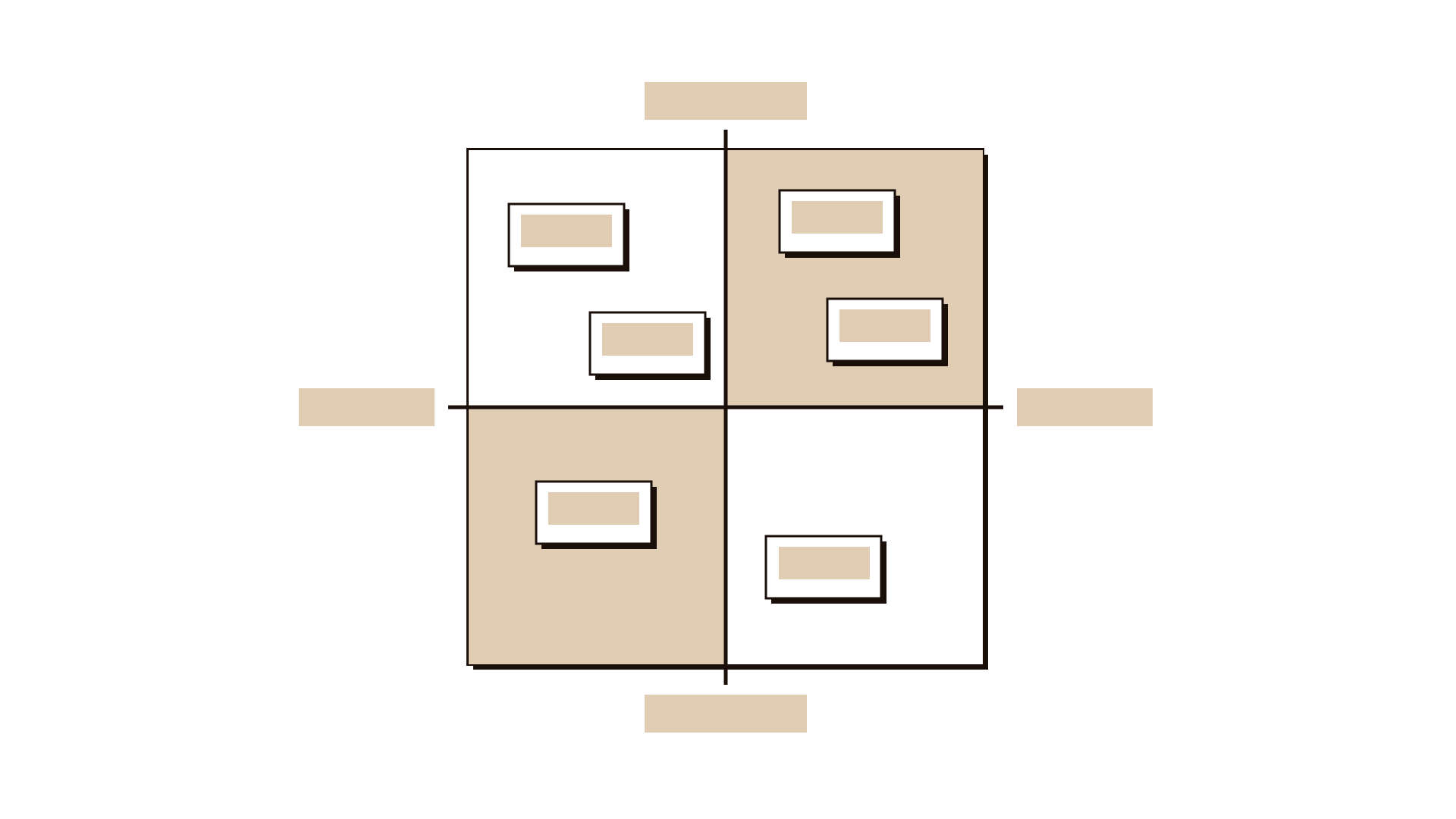
Two axes: how much difference the idea would make, and how hard it is to do. It is the most common tool because everyone understands it in seconds.
Use it to clear the table, not to make the final call. Before placing anything, define impact in one sentence ("fewer applications returned incomplete") and effort in another ("weeks of our team's work, including approvals"). Place ideas relative to each other. Treat the "big bet" corner as things to test, not to build.
2. Dot voting
Everyone gets a fixed number of dots and places them on the ideas they favour. It shows quickly where the group's interest sits. It also lies easily: people vote for what they understood fastest, for what the most senior person seemed to like, and for ideas near the top of the wall.
Make it honest with four rules. Read all ideas silently first. Vote at the same time, not in turn. Give each person roughly a third as many dots as there are ideas, capped at five or six. And state the question being voted on ("Which idea would most reduce repeat visits?"), not "which do you like?". We go further into this in why dot voting lies to you.
3. Weighted decision matrix
List three to five criteria, give each a weight, score each idea against each criterion, multiply and add. Engineers will recognise the family of tools that includes Stuart Pugh's concept selection matrix. It is the method to use when you must explain the choice to someone who was not in the room.
Its weakness is that the weights decide the outcome. Agree and lock criteria and weights before scoring anything. Score one criterion across all ideas at a time, so people compare like with like. Then ask, "Does this feel wrong to anyone, and why?" A surprising result is either an insight or a missing criterion.
4. Now–How–Wow
A grid with two questions: is the idea original, and is it feasible today? "Now" ideas are familiar and doable. "How" ideas are original but not yet feasible. "Wow" ideas are original and feasible. The value is that it protects unusual ideas from being killed by an effort axis in round one.
Use it straight after idea generation. Take "Wow" ideas forward, park "How" ideas with a note of what would make them feasible, and deliver one or two "Now" ideas quickly so the team shows results while bigger work is tested.
5. RICE scoring
Developed by Sean McBride when he was a product manager at Intercom, RICE scores each idea as Reach × Impact × Confidence ÷ Effort. The confidence factor is its best feature: it forces the team to admit how sure it is.
RICE fits teams with a running backlog and rough data on how many people a change would touch. For early ideas, reach and impact are mostly guesses: keep confidence low and visible, and do not let a decimal-point score end the conversation.
How to run a prioritisation session in 90 minutes
- Restate the decision (5 minutes). Write it at the top of the wall: what you are choosing, for what, under which limits.
- Clean the list (15 minutes). Merge duplicates, rewrite vague ideas as a single sentence that starts with a verb, and drop anything that is a problem rather than an idea. Thirty clear ideas beat eighty fuzzy ones.
- First cut (20 minutes). Use impact–effort or Now–How–Wow to reduce the list to eight or fewer. Agree the axis definitions out loud before placing anything.
- Agree criteria and weights (15 minutes). For the shortlist, choose three to five criteria tied to your goal: value to the people you serve, fit with strategy, feasibility, speed to learn. Weight them and lock them.
- Score silently, then compare (20 minutes). Each person scores alone; then reveal and discuss only the scores where people differ by more than two points. Those gaps are where the real disagreement lives.
- Name the riskiest assumption for each top idea (10 minutes). For the top two or three, ask what must be true for the idea to work, and which of those beliefs has the least evidence. That is what you test first. An assumption map does this in one sheet.
- Close with owners and dates (5 minutes). Each chosen idea gets one owner, one test and one review date. Ideas that did not make it go into a visible parking list, with the reason written next to them.
Illustrative example
Illustrative. A regional public library network in the Netherlands ran an idea session on why young adults stop using branches after school. It produced 64 ideas. The team leader had six weeks, two staff and no new budget.
They wrote the decision on the wall: "three ideas to test with real visitors before the summer, with no spend above petty cash." Merging duplicates brought the list to 31. Now–How–Wow put an evening study club, a book-swap shelf and a late-opening trial in "Now", and a partnership with a local music school in "Wow". A weighted matrix on four criteria (value to young adults, cost, how fast we learn, staff load) put the study club, the music partnership and a redesigned welcome desk on top.
For the music partnership, the riskiest assumption was whether the school would share rooms in the evening. One phone call became the first test. The popular late-opening idea went to the parking list with the note "needs union and security discussion; revisit in autumn".
Do's and don'ts
Do
- Write the decision and its limits before showing any ideas.
- Define each axis or criterion in one sentence everyone agrees with.
- Have people judge silently and reveal together.
- Treat the top of the list as things to test, not things to build.
- Record why ideas were left out, so they can come back.
Don't
- Let the most senior person speak first about any idea.
- Add or change criteria after you have seen the scores.
- Prioritise 80 raw ideas in one pass; cut first.
- Use a precise score to hide that every input was a guess.
- Mix problems, ideas and solutions on the same wall.
Questions people ask
What is the best method to prioritise ideas? There is no single best one. For a fast first cut, use an impact–effort matrix or Now–How–Wow. For a final choice you have to justify, use a weighted decision matrix. Use dot voting to read the room, never as the only basis for a decision.
How many ideas should we choose? Usually two or three to test at once with a small team. More than that and none gets proper attention. Choose by how many tests you can run and review in parallel, not by how many ideas look good.
Is MoSCoW a good way to prioritise ideas? MoSCoW (must, should, could, won't), associated with Dai Clegg and the DSDM agile method, is built for scoping requirements inside a project that is already agreed. It is useful once you know what you are building and less useful for choosing between new ideas.
Where to go next
Start with the impact–effort matrix for your first cut and the weighted decision matrix for the final choice. If your list is full of bold ideas, try Now–How–Wow, and if you must vote, read the dot voting guide first. Once you have a shortlist, see how to test an idea before you build it, or return to which innovation tool to use for the full map of methods.