
Three horizons
See what is fading, what is emerging and what sits between, then choose the experiments that move you from one to the next.
- Time
- 60 min
- People
- 5–8
- Kind of work
- Frame · Plan

In short
Three horizons is a futures method that looks at three patterns at once: the current way of doing things (horizon 1), a desired future pattern (horizon 3), and the transitional innovations between them (horizon 2). The team maps each, notes signals of change, and chooses transition experiments. A first session takes about an hour.
What it is
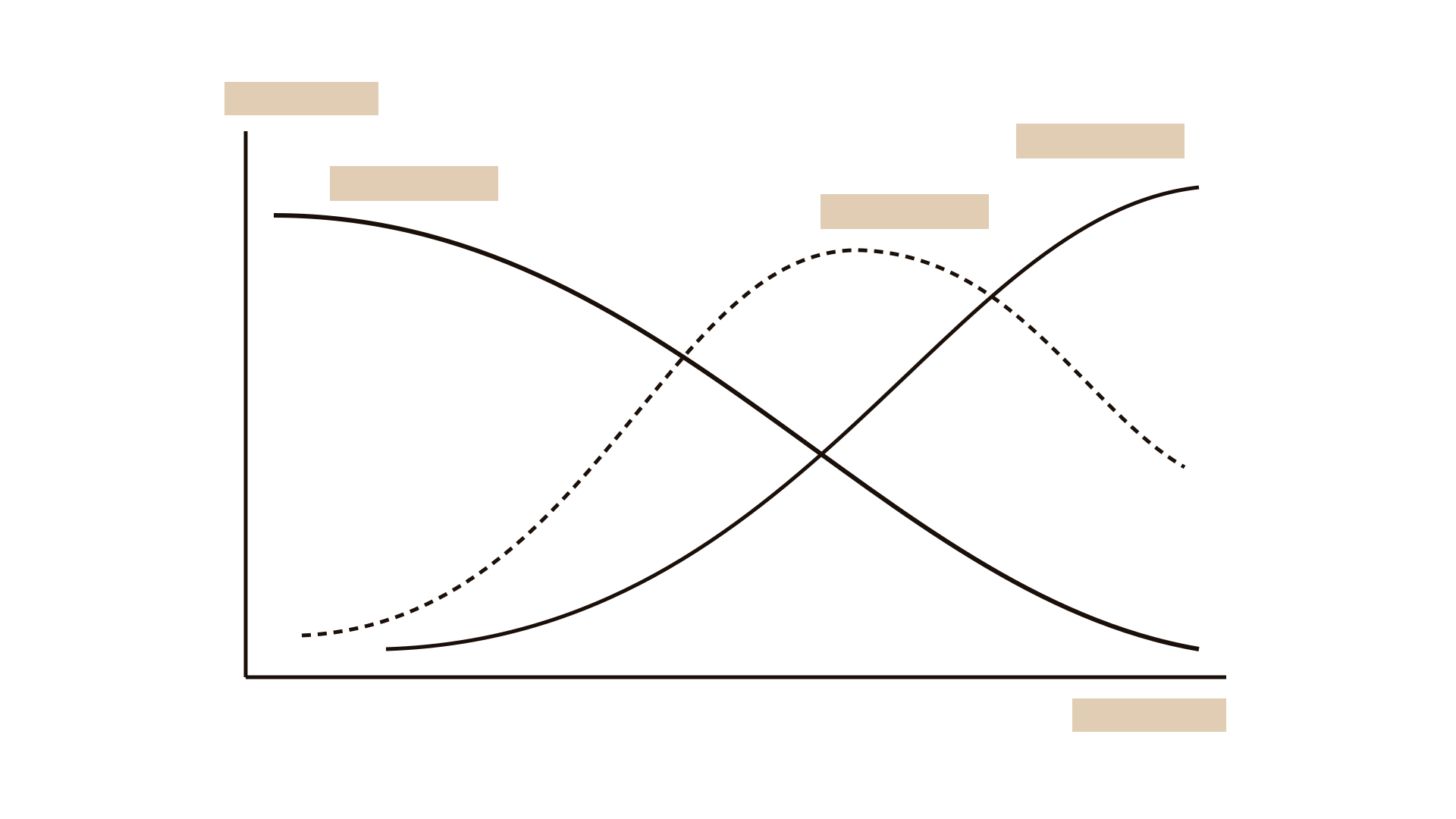
Picture three curves on a chart. The first is the way things are done today. It is dominant now, but it is slowly losing fit with the world. The third is a future pattern that would fit much better; today it exists only in small pockets. The second curve sits between them: the experiments, workarounds and new practices that could carry you from the first to the third. The method was developed in futures practice and is used widely in public policy and system change.
Two cautions matter. First, the horizons are patterns, not dates. Horizon 3 is not the year 2040; it is a way of working that may already exist somewhere. Second, horizon 1 deserves respect. It keeps the service running today, and the transition must look after the people who depend on it.
When to use it
Use it when
- When a team knows its current model is under strain but cannot agree on what comes next.
- When you have a long-term vision and need to connect it to practical steps now.
- When several innovation pilots are running and you want to see which ones lead somewhere.
- After scenario work, to think about how to move toward the future you prefer.
Skip it when
- When the task is to fix a defined problem inside the current model. Use a root-cause or process tool.
- When the group has no shared sense of the future it wants. Spend time on a vision or scenarios first.
You need
- Time
- 60 minutes for a first map. Many teams return for a second session after collecting examples.
- People
- 5 to 8 people, mixing those who run today's service with those working on new approaches.
- Materials
- A wall with three large curves drawn across it (one falling, one rising, one between), sticky notes in three colours, markers.
How to run it
Step 1: Agree the system you are looking at
Name it on the wall in a few words, such as how our hospital follows up with patients after discharge. Keep it specific enough that everyone pictures the same work.
Step 2: Describe horizon 1
For 10 minutes, write the current pattern on the falling curve. What do we do now? What works and must be protected? Where is it losing fit, and how can you tell? Ask people who run the service to lead this part.
Step 3: Describe horizon 3
Next, write the desired future pattern on the rising curve. What would follow-up look like if it fitted the needs of patients and staff well? Then ask: where does a piece of this already exist today, here or elsewhere? Those pockets are your evidence.
Step 4: Map horizon 2
On the middle curve, list the innovations and changes already under way or proposed. For each, ask whether it moves toward horizon 3 or simply makes horizon 1 last longer. Both kinds are valid; label them so you can tell them apart.
Step 5: Add signals
Write two or three signals for each horizon: signs that horizon 1 is losing fit, and signs that horizon 3 is spreading. Signals should be observable, such as a rise in readmissions or a team adopting a new practice.
Step 6: Choose transition experiments
Pick two or three horizon 2 actions to test in the next three months. Each should be small, reversible and connected to horizon 3. Write who will run it, what you will learn, and what must be protected in horizon 1 while it runs.
Worked example
A general hospital wanted to reduce readmissions after discharge. Seven people met: two ward nurses, a pharmacist, a discharge coordinator, a digital lead, a patient experience officer and a facilitator.
Horizon 1 was a printed discharge letter, a follow-up appointment in four to six weeks, and phone calls only when something went wrong. It worked for routine cases. Signs of strain were rising readmissions within 30 days among older patients on several medicines.
Horizon 3 was continuous, light-touch support at home, with problems spotted early. The team found pockets of it already: one ward's pharmacist made a call on day three to patients on blood thinners.
Horizon 2 included a text reminder system already being piloted, a plan to add more follow-up clinics, and a family briefing at the bedside. The group labelled the extra clinics as extending horizon 1, and the day-three call and family briefing as moving toward horizon 3.
Signals to watch were readmission rates by ward and the number of patients reached in the first week.
The team chose two experiments: extend the day-three pharmacist call to one more ward, and test a ten-minute family briefing with 20 patients. They agreed the existing outpatient follow-up would continue unchanged during the tests.
IllustrativeTips and mistakes
Tips
- Start with horizon 1 and treat it fairly. People who run it will engage more once its value is named.
- Look for horizon 3 in the present. If nobody can point to an example anywhere, the vision may be too abstract.
- Use three colours of sticky note so the horizons stay visible from across the room.
- Keep the drawing on the wall for the next session. Moving notes between curves over time is part of the learning.
Common mistakes
- Treating the horizons as one, three and ten years. They are patterns, and they overlap in time.
- Describing horizon 1 only as the problem, which makes the people who run it defensive.
- Filling horizon 2 with every project in the organisation instead of the changes that relate to this system.
- Ending with a vision and no experiments.
What you walk away with
You leave with a shared picture of the current pattern, a desired future pattern with real examples, a sorted list of transitional changes, and two or three experiments with owners. Feed the experiments into a roadmap, and use portfolio mapping if you need to compare them with other initiatives competing for the same people.
Questions people ask
What are the three horizons?
Horizon 1 is the current dominant way of doing things. Horizon 3 is a desired future pattern that would fit better. Horizon 2 is the space of transitional innovations between them. All three exist at the same time; they are not a timeline.
Is this the same as the three horizons of growth used in business?
They share a name and a three-curve picture, but they serve different purposes. The business version usually sorts products by time to revenue. The futures version used here looks at how one way of working gives way to another.
How long does a three horizons session take?
About an hour for a first map with five to eight people. A deeper version, with examples gathered between sessions, usually takes two or three meetings.
Tool card
The worksheet your team fills in, one box per field.
- Horizon
- Current pattern
- Emerging pattern
- Transition
- Signal