
Why your workshop ended in photos of sticky notes
A wall of sticky notes feels like progress. Why workshop outputs die in photo albums, and how to turn them into decisions, owners and next steps.

Why your workshop ended in photos of sticky notes
A wall covered in sticky notes looks like the result of a good workshop. Usually it is the raw material for one that hasn't finished. The belief that "we captured everything, we'll make sense of it later" is why so many sessions end in a phone album and a summary nobody reads. The fix is to do the sense-making and the deciding in the room, while the people who wrote the notes are still there to explain them.
The belief, stated fairly
The case for the photo is reasonable. Workshops are tiring. Synthesis takes time and quiet. A small team can cluster the notes properly afterwards, write a clean report, and send it to everyone. Rushing to conclusions at 4pm risks shallow thinking. Better to capture everything and reflect.
Some of this is true. Deep analysis of research data, for example a hundred interview quotes, does need time away from the room. But most workshops aren't producing research data. They are producing options and opinions that need to be turned into choices. And for that, "later" has three problems.
Why "we'll make sense of it later" fails
The meaning leaves with the people. A sticky note is a compressed thought. "Queue info!!" means something precise to the person who wrote it and almost nothing to the analyst reading it on Thursday. Once the room empties, the synthesis team is interpreting fragments, and their interpretation drifts towards what they already believed.
Nobody owns the output. In the room, there were twelve people. In the follow-up, there is one tired facilitator. The report arrives two or three weeks later, by which time the energy has gone, priorities have moved, and the people who were in the room no longer recognise their own ideas in it.
A summary isn't a decision. Most workshop reports describe what was discussed. Few state what was decided, by whom, and what happens on Monday. A report that says "the group identified five themes" leaves every reader free to carry on as before.
There is also a quieter cost. When people see their contributions disappear into a photograph, they learn that workshops are theatre. Next time, they bring less. Over a year, this is how the "innovation culture dies after the launch event" pattern sets in, as we describe in why innovation culture dies after the launch event.
What works instead
1. Decide what the wall is for before you fill it
Every wall of notes should have a job: to find patterns, to choose options, or to surface risks. If you can't say which, you'll end up with a pile. Put the job at the top of the wall in writing. The pillar guide, how to run a workshop that ends in decisions, shows how to design the whole day backwards from the decision.
2. Make sense in the room, with the authors
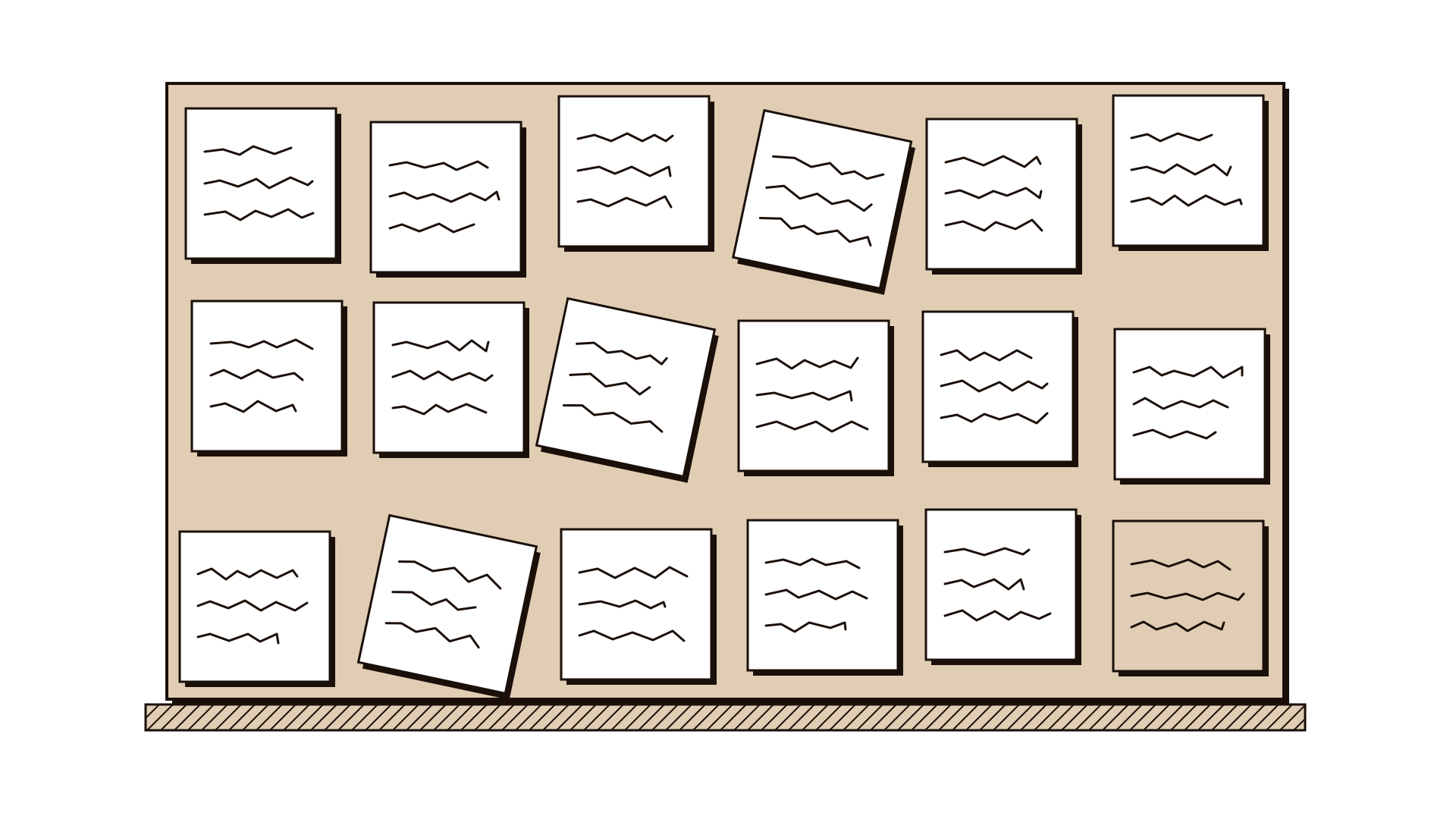
Run affinity grouping together rather than afterwards. The method descends from Jiro Kawakita's KJ method, developed in Japan in the 1960s, and its value comes from people arguing about what belongs together. Ask authors to read their notes aloud as they place them. Label clusters with a full sentence that makes a claim ("New customers don't know how long they will wait"), not a topic word ("Waiting").
3. Turn clusters into statements you can act on
A cluster is still not a decision. Convert the strongest two or three into a point of view: who is affected, what they need, and the insight that explains why. If the group is choosing between many possible responses, an opportunity solution tree, a structure popularised by product coach Teresa Torres, links each idea back to the outcome it serves, which makes weak ideas easy to drop.
4. Choose, then assign
Sort what remains with an impact–effort matrix or against criteria agreed earlier. Then assign. Each chosen item gets an owner, a first step and a date. If ownership crosses teams, a five-minute RACI prevents the "I thought you had it" gap.
5. Photograph the decision record, not the wall
If you take one photo, take it of the table that lists decisions, owners and dates. Send that table within 24 hours. The cleaned-up record of every note can follow, but it's an archive, not the output. The facilitator's checklist covers what to send and when.
6. Close the loop with contributors
A week later, tell the room what happened to their ideas, including the ones that were dropped and why. A short feedback capture grid at the end of the session (what worked, what to change, questions, new ideas) also gives you material to improve the next workshop.
Illustrative example: a city council's housing team
Illustrative. A city council housing team in Canada held a workshop on repairs complaints. By 3pm there were roughly two hundred notes across four walls. The facilitator's plan had been to photograph everything and produce a synthesis report the following week.
Instead, with ninety minutes left, she changed the plan. The group spent forty minutes clustering together, with each person reading their notes aloud. Clusters were labelled as claims: "Tenants report the same repair several times because they get no confirmation." Three clusters were turned into point-of-view statements. The team scored the responses quickly on impact and effort and picked two: an automatic confirmation text and a single named contact for repeat repairs. Each got an owner and a date. The photograph that went to the director that evening was of a table with two rows. The full set of notes was typed up later as an appendix that a few people actually opened.
Do's and don'ts
Do
- Write the wall's job at the top before anyone adds a note.
- Cluster with the authors in the room.
- Label clusters as claims, not topics.
- Leave the room with owners and dates.
- Send the decision table within a day; the archive can wait.
Don't
- Plan to "synthesise later" when the purpose is to choose.
- Let one person do the clustering while the group takes a break.
- Send a report that lists themes but no decisions.
- Forget to tell contributors what happened to their ideas.
For more ways good ideas get lost along the way, see 7 workshop mistakes that kill good ideas.
Questions people ask
How do you synthesise workshop results quickly? Do it in the room. Cluster together with authors explaining their notes, label each cluster as a claim, convert the top few into problem statements and choose responses against agreed criteria. Forty to sixty minutes is usually enough for a group of ten.
What should a workshop report include? Lead with the decisions: what was chosen, who owns it, the first step and the date. Then what was considered and dropped, and why. Put the raw notes in an appendix.
Is it ever right to analyse sticky notes after the workshop? Yes, when the notes are research data, such as observations or interview quotes, that need careful coding. Even then, agree in the room what question the analysis will answer and when the group will meet again to decide.
Where to go next
The methods that turn a wall into a decision are affinity grouping, point of view, the opportunity solution tree and the impact–effort matrix. Browse the rest in the method guides.