
Objectives and key results (OKRs)
Say where you want to get to in words people care about, then agree the few numbers that will show you got there.
- Time
- 45 min
- People
- 4–8
- Kind of work
- Plan · Scale

In short
Objectives and key results (OKRs) is a goal-setting method. The objective is a short, meaningful statement of the outcome you want. Key results are two to four measurable changes that show the objective has been reached, each with a baseline, a target and an owner. Teams review progress at a regular check-in, often every two weeks.
What it is
An OKR has two parts. The objective answers what do we want to achieve, and why does it matter? It is written in plain words that a team can rally around. The key results answer how will we know? They are measurable changes in outcomes, not a list of tasks. If every task were done and nothing changed for the people you serve, the key results should show that.
OKRs work best for a fixed period, usually a quarter, and in small numbers. One team might hold one to three objectives, each with two to four key results. The method is popular because it is light: one page, a regular check-in, and an honest conversation about progress. It is used across private companies and public bodies.
When to use it
Use it when
- At the start of a quarter, to turn a broad priority into something a team can track.
- When a team is busy but cannot say what difference its work is making.
- When several teams need to pull in the same direction without a heavy planning process.
- After a strategy has been set, to translate it into near-term outcomes.
Skip it when
- When the team has no agreed direction yet. Frame the problem or strategy first.
- When the measures would be used to judge or rank individuals. OKRs describe team outcomes.
- For routine operational work that is already well measured by service levels.
You need
- Time
- 45 minutes for a first draft, plus a 15-minute check-in every two weeks.
- People
- 4 to 8 people from the team that will own the work, with access to someone who knows the data.
- Materials
- Current figures for the outcomes you care about, a worksheet with six fields, and a board or shared document.
How to run it
Step 1: Choose a meaningful outcome
Ask: if we achieve one thing this quarter, what should it be? Write it as a short objective in plain language, such as New residents can start using our services in their first week. Avoid numbers here.
Step 2: Draft key results
Give the group 10 minutes to propose measurable results that would show the objective is met. Each should describe a change in an outcome, such as a time, a rate or a count of people helped. Collect them all before choosing.
Step 3: Cut to two to four
Choose the key results that together give a fair picture. Drop tasks dressed as results, such as launch the new form. Keep results that would still matter if the plan changed.
Step 4: Set baseline and target
For each key result, write today's value and the value you aim for by the end of the period. If there is no baseline, make finding it the first piece of work. Targets should feel stretching but possible.
Step 5: Assign an owner
Name a role responsible for each key result. The owner tracks progress and raises problems early; they do not do all the work alone.
Step 6: Agree the check-in rhythm
Set a short, regular review, often every two weeks. At each check-in, update the figure, say what helped or blocked progress, and agree one next step. Keep it to 15 minutes.
Worked example
The new customer team at a retail bank was asked to improve how people opened accounts on their phones. Six people spent 45 minutes drafting OKRs for the coming quarter.
The first objective draft was improve digital onboarding. The group rewrote it to: New customers can open an account on their phone without having to visit a branch.
Ten key results were proposed. Three were tasks, such as redesign the identity step, and were moved to the team's plan instead.
They kept three: the share of applications completed on the phone, from 54% to 70%; the median time to open an account, from 3 days to 1 day; and branch visits needed to finish an application, from 1 in 5 to 1 in 12.
One key result had no reliable baseline. The analyst role took on measuring it in the first two weeks.
Check-ins were set every second Sunday. By week six, completion had risen to 61%, and the team used the check-in to shift effort toward the identity step, where most people stopped.
IllustrativeTips and mistakes
Tips
- Read the objective aloud. If nobody in the room would care whether it happened, rewrite it.
- Test each key result by asking: could we hit this and still fail the objective? If yes, add a balancing result.
- Keep OKRs visible. A single page on the wall or the team's home screen does more than a slide no one opens.
- Treat a missed target as information. The useful question is what you learned, not who is to blame.
Common mistakes
- Writing a list of tasks and calling them key results.
- Setting too many objectives, so focus disappears.
- Using OKRs to assess individual staff, which makes people set safe targets.
- Writing OKRs once and never checking in.
What you walk away with
You leave with one to three objectives for the period, each with two to four key results, baselines, targets, owners and a check-in date. If you need to see how the key results connect to bigger organisational measures, build a KPI tree. If the team needs a longer-range plan that links direction to strategies, try OGSM.
Questions people ask
How many key results should an objective have?
Two to four is a good range. One rarely gives a fair picture, and more than four usually means some are tasks or the objective is too broad.
What is the difference between OKRs and KPIs?
KPIs are ongoing measures of how well something is running. OKRs are time-bound goals for change. A KPI can become a key result when you set out to move it during a quarter.
Should OKRs be linked to pay or performance reviews?
It is generally better not to. When targets affect individual reviews, people tend to choose safe goals. OKRs work best as a shared team tool for focus and learning.
Tool card
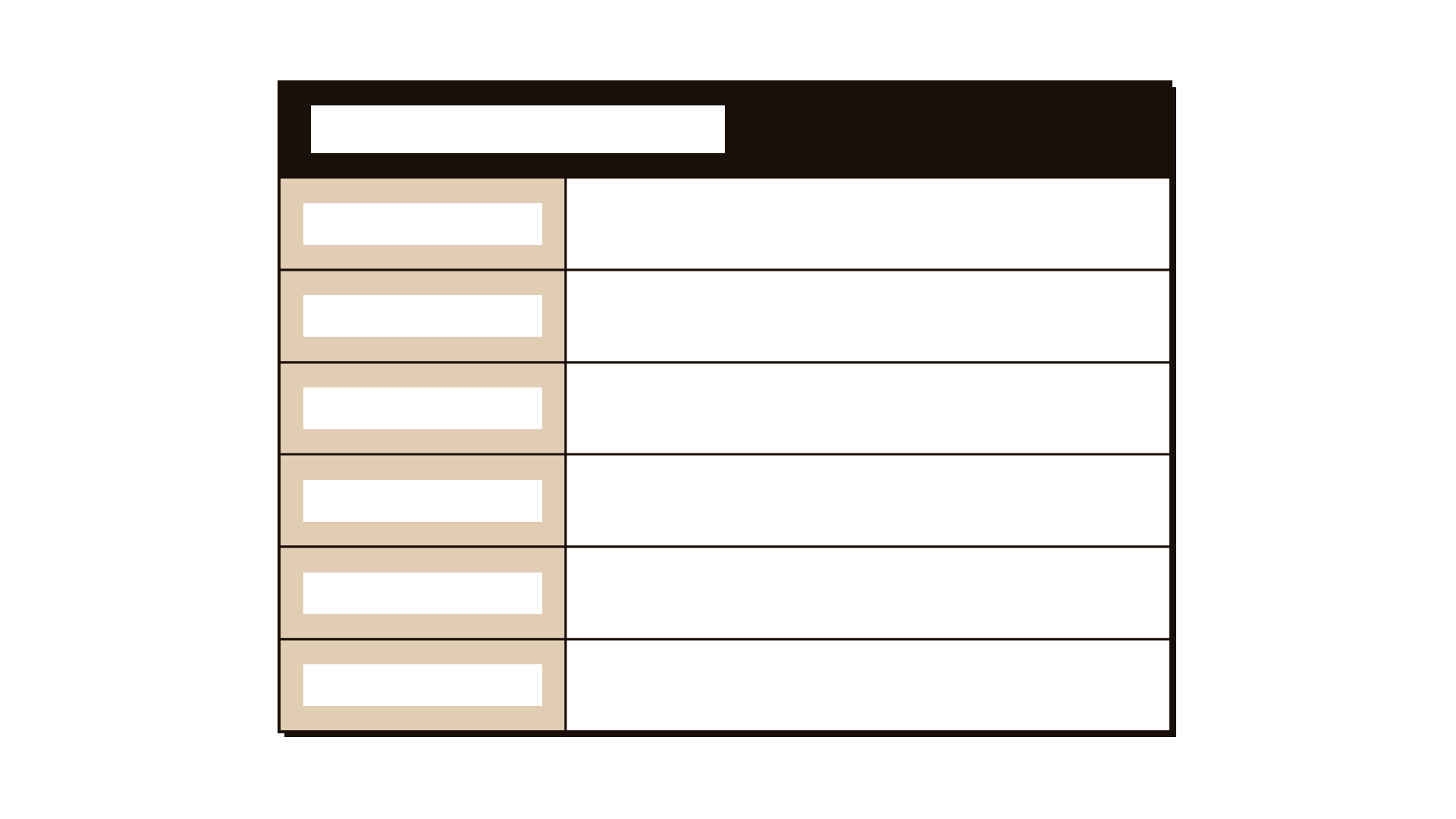
The worksheet your team fills in, one box per field.
- Objective
- Key result
- Baseline
- Target
- Owner
- Check-in